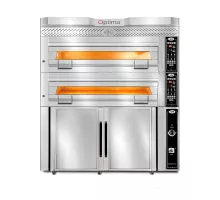
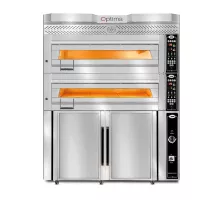
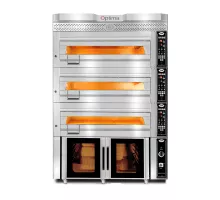
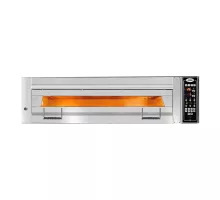
.webp "GS24.lv")
 +371 29 148 185
 WhatsApp
 info@gs24.lv
 Contacts
Bakery and confectionery ovens are used in bakeries, pastry shops, cafés, restaurants, hotels, retail stores with in-house baking and production kitchens. They are used for baking bread, rolls, croissants, pies, cookies, sponge cakes, tartlets, puff pastry products and other items where stable temperature, even convection, humidity, loading volume and repeatable results are important.
This type of oven should not be selected only by external size or number of levels. For professional baking, tray format, distance between runners, heating type, steam or humidification, air flow uniformity, power, temperature range, temperature recovery after loading and staff convenience are important.
Related oven and accessory sections
- Ovens — general section for professional ovens for kitchens, bakeries, pastry production and HoReCa;
- Combi steamers — universal ovens with steam, convection and cooking programs;
- Multi-size Ovens GN 1/1 & 60×40 — equipment for kitchens where GN containers and bakery trays must be combined;
- Convection Ovens — ovens for even baking, reheating and cooking through hot air circulation;
- Bakery oven — solutions for pastry products, cookies, tartlets and puff pastry;
- Rotary Convection Ovens for Pastry — ovens for even baking with larger loads;
- Baking Oven — compact solutions for baking, roasting and heat treatment;
- Oven Stands — bases and stands with or without runners;
- Accessories for ovens — trays, runners and related positions for working with ovens.
Where these ovens are used
Bakery and confectionery ovens are selected where the result must be repeatable: consistent crust, stable dough rise, even colour, correct baking inside and controlled humidity. This is important both for a small café with in-house baking and for a bakery, pastry workshop or retail store where baked goods are a separate sales direction.
- baking bread, baguettes, rolls and small bakery products;
- preparing croissants, puff pastry and yeast products;
- baking cookies, tartlets, sponge bases and pastry products;
- working with frozen semi-finished products and bake-off items;
- baking in cafés, restaurants, hotels and shops;
- production work in a bakery or pastry workshop;
- reheating, regeneration and final baking before serving.
Tray format and loading
One of the main parameters is tray format. For bakery and pastry work, 600x400 mm is common, but professional kitchens may also use GN formats. Before choosing an oven, it is necessary to understand which trays, sheets, moulds and products the staff will use.
It is important to consider not only the number of levels but also the distance between runners. Low products can use more levels, while bread, rolls, tin-baked products and items with dough rise require more height. If the distance between levels is wrong, the oven may formally fit the number of trays but be impractical for the real assortment.
Convection, steam and humidity
Convection distributes hot air evenly inside the chamber. For cookies, puff pastry and small bakery products, stable air circulation without overdrying and sudden changes is important. For bread, rolls and yeast products, steam or humidification may be important, especially at the start of baking.
If the oven is used for a wide assortment, it is necessary to understand which modes are really needed: simple convection, humidification, steam, programming, several fan speeds, fan reverse, precise temperature regulation and repeatable cycles.
Proofing, dough preparation and process organisation
Baking quality depends not only on the oven. Dough mixer, proofing, dough temperature, humidity, product preparation, loading time and stable staff workflow are important. Even a good oven will not correct errors in dough preparation, wrong proofing or chamber overloading.
- for yeast products, the oven should be connected with the proofing process;
- for puff pastry, temperature, fan speed and air uniformity are important;
- for bread, starting temperature, steam and chamber stability are important;
- for cookies and tartlets, even colour across the whole tray area is important;
- for frozen semi-finished products, repeatable programs and fast temperature recovery are important.
Practical notes from bakers, pastry chefs and technologists
- the oven should be selected by assortment, not only by number of levels;
- 600x400 format is convenient for bakery and pastry work, but it does not always replace GN format in a kitchen;
- overloading the chamber worsens air circulation and baking uniformity;
- products with dough rise require enough distance between runners;
- frequent door opening lowers temperature and affects the result;
- steam and humidification are not needed for every product, but for bread and some yeast products they can be critical;
- if baking is uneven, check not only the oven but also loading, trays, program and dough preparation.
Common mistakes when choosing
- choosing an oven only by external dimensions;
- not checking tray format and runner distance;
- confusing pastry ovens, convection ovens and combi steamers;
- not considering the assortment: bread, puff pastry, cookies, sponge bases and frozen products need different modes;
- choosing a chamber that is too small for the real load;
- not considering connection, power, ventilation and installation space;
- buying an oven without understanding proofing, dough preparation and serving workflow.
Why GS24.lv / GASTROserviss for oven selection
- more than 20 years of work with professional HoReCa equipment, bakery and kitchen solutions;
- we select ovens not only by size, but by assortment, tray format, load, modes, power and working process;
- we consider real tasks: café, restaurant, shop with baking, bakery, pastry workshop, hotel or production kitchen;
- we help connect the oven with other process elements: proofing, trays, stands, accessories, ventilation and service;
- we understand the difference between convection ovens, pastry ovens, combi steamers and universal ovens;
- we help choose a solution that fits the real assortment and does not complicate staff work.
Request bakery oven selection
For accurate oven selection, it is useful to specify which products will be baked, which tray format is used and what load is needed per hour or shift.
- assortment: bread, rolls, croissants, puff pastry, cookies, sponge cakes, pies or frozen semi-finished products;
- tray format: 600x400, GN or another size;
- whether steam, humidification, programming and several fan speeds are needed;
- approximate load per cycle, hour or shift;
- available connection, power, installation space and ventilation;
- whether stands, runners, trays, accessories or service are needed.
FAQ
1. How does a bakery oven differ from a standard convection oven?
A bakery oven is selected by assortment, tray format, baking uniformity, distance between levels, humidity and result stability. A standard convection oven may not fit every bakery and pastry task.
2. Which tray format is better for a bakery or pastry workshop?
The 600x400 mm format is often used, but the choice depends on assortment, existing trays, products, baking volume and whether the oven must be combined with GN kitchen formats.
3. Is steam needed for baking bread and rolls?
For bread, baguettes and some yeast products, steam or humidification may be important at the beginning of baking. For cookies, tartlets and some pastry products, even convection and precise temperature are often more important.
4. How many levels should the oven have?
The number of levels depends on load, product height, distance between runners and tray format. More levels are not always better if products need space to rise.
5. Can one oven be used for bread, rolls and pastry products?
Yes, but temperature range, convection, humidity, tray format, distance between levels and repeatable programs for different products must be checked.
6. When is a proofer needed near the oven?
A proofer is needed for yeast products, bread, rolls, croissants and items where controlled dough rise before baking is important. Without proper proofing, even the right oven will not give stable results.
7. What is more important: oven power or baking uniformity?
Both are important. Power affects heating speed and temperature recovery after loading, while convection uniformity affects even colour and baking across the tray.
8. What accessories are needed for the oven?
Usually the oven needs trays of the correct format, runners, stand, extraction hood or ventilation solution, oven gloves, trolleys, moulds and other accessories for the specific assortment.
9. What should be checked before buying an oven?
Assortment, tray format, load, runner distance, steam, power, connection, ventilation, installation space, washing convenience and compatibility with the kitchen process should be checked.
10. Why can baking be uneven?
The reason may not be only the oven. Chamber loading, distance between products, tray format and quality, fan mode, temperature, door opening frequency, dough preparation and proofing should be checked.