 +371 25 856 856
 WhatsApp
 shop@gastroserviss.lv
 Contacts
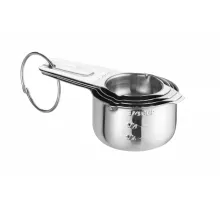
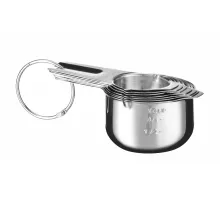
Measuring cups, jugs and spoons for professional kitchens are used to measure liquid and dry ingredients, prepare mixtures and follow recipes. Suitable measuring utensils help keep portions consistent and simplify ingredient preparation at the workstation.
The category includes measuring cups and jugs in different capacities, as well as measuring spoon sets. Choose the utensil according to the quantity and task: spoons are convenient for small doses, while cups and jugs suit larger volumes.
What this category includes
- Measuring cups — for measuring and preparing ingredients.
- Measuring jugs — for measuring volume, mixing and pouring.
- Measuring spoons and sets — for small quantities of liquid and dry ingredients.
Graduations, materials, temperature limits and cleaning methods depend on the specific product. Check each model for a handle, pouring spout or stackable design.
Where measuring utensils are used
- Restaurants and cafés — for sauces, dressings, stocks and mixtures.
- Bakeries and confectioneries — for preparing ingredients for doughs, creams and fillings.
- Bars and beverage stations — for preparing bases and mixtures according to recipes.
- Preparation areas — for repeated dosing and distributing ingredients.
Main selection criteria
- Working capacity. Choose a vessel that suits your usual ingredient quantity. A large jug is not always convenient for a small amount.
- Graduation intervals. The markings should allow the required volume to be measured without estimating between widely spaced divisions.
- Units of measurement. Check the scale markings and their compatibility with the recipe.
- Readability. Numbers and markings should be clearly visible under workplace lighting.
- Material. Consider food contact, ingredient temperature and permitted cleaning methods.
- Shape and handling. A handle, spout and stable base matter when filling and pouring.
- Storage. Stackability is useful for several vessels when the design supports it.
- Set contents. Check the capacity of each spoon or vessel in a set.
Measuring volume and weighing
Measuring utensils measure volume. Scales measure mass. Millilitres cannot automatically be treated as grams: the relationship depends on the ingredient’s density.
For flour, sugar and other dry ingredients, filling and compaction also affect the amount held in a measuring vessel. If a recipe specifies grams or requires precise mass control, use scales.
Practical recommendations
- Read the liquid level on a flat surface with your eyes level with the relevant marking.
- Do not treat space above the highest graduation as a verified measuring range.
- For measuring spoons, follow the recipe’s filling instruction: level or heaped.
- Before handling hot ingredients, check the product’s permitted temperature.
- Follow the manufacturer’s instructions for washing and detergents.
- Replace damaged products or those with unreadable graduations if this prevents safe, repeatable dosing.
Frequently asked questions
How does a measuring jug differ from an ordinary jug?
A measuring jug has graduations for determining volume. An ordinary jug may state only its total capacity, without markings for dosing.
Can a measuring cup measure grams?
A millilitre scale shows volume. To determine mass, use scales or a dedicated graduation for the particular ingredient, following its conditions of use.
Are measuring spoons suitable for both liquid and dry ingredients?
Yes, provided the material is suitable for the ingredient. Consistent filling and following the recipe are important for repeatable results.
Are all measuring jugs suitable for hot liquids?
No. The permitted temperature depends on the material and specifications of the particular product.
Can measuring utensils be washed in a dishwasher?
Only if the manufacturer permits this cleaning method. This is especially important for preserving the graduations and the product’s shape.
Is one large jug enough, or are several capacities better?
Several working capacities are more convenient for different quantities. Small amounts are easier to measure in a vessel with suitable graduations than in a large jug.
Choosing measuring utensils with GS24.lv / GASTROserviss
Specify the ingredients, usual dosing volume, required graduation interval and working temperature. Also consider cleaning methods and available storage space.
This helps select cups, jugs and spoons for actual kitchen tasks and avoids awkward dosing.